



Discovering Candidate Disease Genes
Our approach when diagnostic exome sequencing reports candidate genes that could explain rare disease.
Exome Sequencing: Diagnostics and Discovery
Clinical diagnostic exome sequencing (DES) offers a dual role as a diagnostic and discovery tool by:
- Making large-scale genetic testing more affordable and accessible
- Accelerating the rate of scientific discovery of candidate disease genes, increasing our ability to clarify a genetic diagnosis
Ambry’s clinical reporting of candidate genes identified via DES relies on comprehensive, rule-based scoring criteria. Heavily weighting both gene and variant classification, this rigorous process incorporates evidence from:
- Studies of gene function alongside tissue and developmental stage expression
- In vitro or in vivo functional studies
- Knowledge of the gene family and/or pathway
- Animal models and familial co-segregation analysis
Applying Our Candidate Gene Criteria
We achieve a candidate gene detection rate of nearly 8% among patients referred for diagnostic exome sequencing. Among the first 1,500 patients referred for exome sequencing, both characterized and uncharacterized genes were analyzed for 934 patients, among whom 72 (7.7%) had a reported candidate (see table below). Among these 72 patients, 37 (4.0%) received “candidate” evidence scores and 35 (3.7%) received “suspected candidate” scores (see table below).
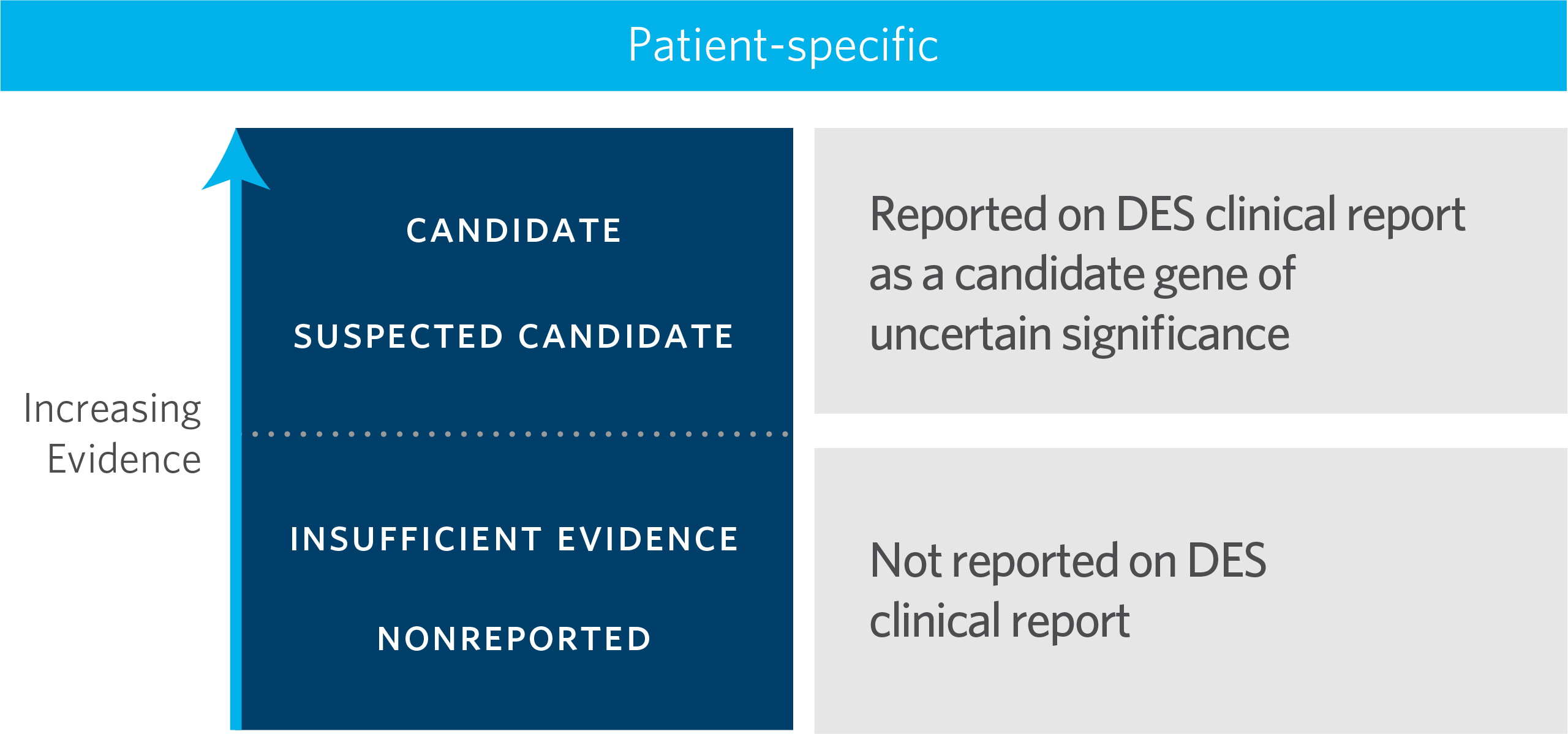
Reports with candidate gene findings, which are always interpreted as uncertain findings, fall under one of two categories: “Candidate” or “Suspected Candidate,” depending upon the level of evidence achieved. See details about our candidate gene criteria in image to right.
Candidate Gene Rates and ExomeNext Testing
| Evidence Category | Patients With Candidate Gene Results |
|---|---|
| Candidate | 4.0% |
| Suspected Candidate | 3.7% |
| Total | 7.7% |
Achieving Peer-Reviewed Candidate Gene Corroboration
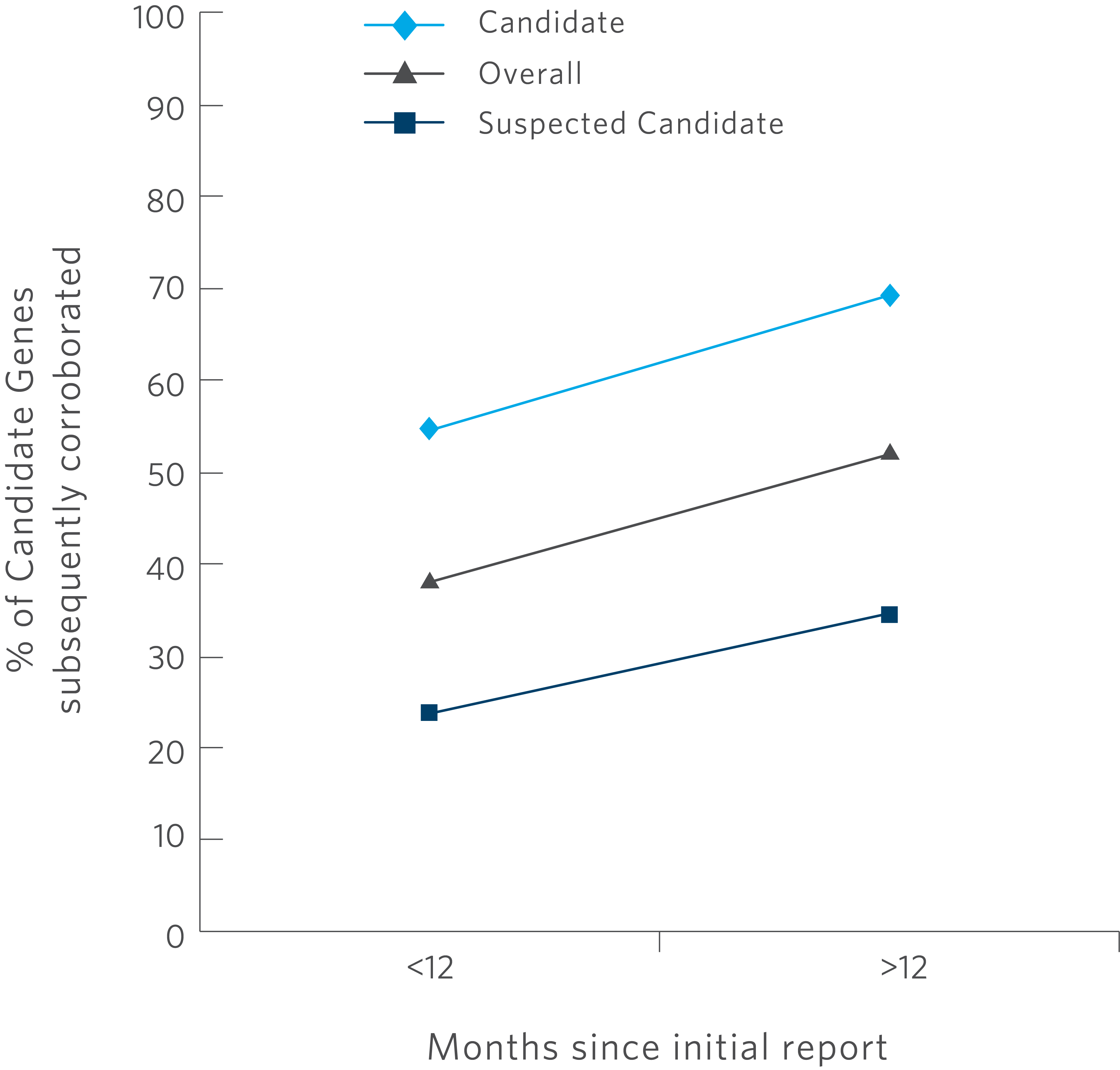
Over half of all reported candidate genes were subsequently corroborated in the peer-reviewed literature among genes reported >12 months prior (Fig 2). Among candidate genes reaching “candidate” and “suspected candidate” evidence levels, 54.5% (18/33) and 23.7% (9/38) had subsequent corroborating publications, respectively (P = 0.014). The candidate genes described include those reported through November 2015. To determine whether time to publication was a factor for peer-reviewed corroboration, we further restricted the analysis to candidate genes reported through December 2014. In this cohort with at least 12 months available for subsequent corroboration (n = 52), the corroboration rate increased to 51.9% (27/52) overall and to 69.2% (18/26) among genes reaching candidate evidence and 34.6% (9/26) for genes reaching suspected candidate evidence.
Terminology
| Characterized Mendelian Disease Gene | A gene known to underlie at least one Mendelian genetic condition |
| Uncharacterized Mendelian Disease Gene | A gene that is not currently known to underlie a Mendelian genetic condition |
| Clinical Validity | Based on existing literature and knowledge about gene-disease relationships, clinical validity is the determination that a particular disease is truly caused by pathogenic variants in a particular gene. |
| Uncharacterized Gene-Disease Relationship | A gene-disease relationship and/or mechanism not previously proposed or with limited evidence based on clinical validity assessment |
| Characterized Gene-Disease Relationship | A disease or phenotype whose underlying molecular etiology is established with at least moderate level of evidence based on ClinGen clinical validity assessment |
| Candidate Gene Criteria | Standardized criteria scheme to evaluate the level of available evidence to propose a candidate gene-disease relationship in a previously uncharacterized gene-disease relationship |
| Idiopathic Disease | A disease or phenotype whose underlying molecular etiology or etiologies have not been established. For heterogeneous conditions, there may be multiple etiologies. |
References
- Kelly D. Farwell Hagman MS, CGC, Deepali N. Shinde PhD, Cameron Mroske MS, Erica Smith PhD, Kelly Radtke PhD, Layla Shahmirzadi, MS, CGC, Dima El-Khechen MS, CGC, Zöe Powis MS, CGC, Elizabeth C. Chao MD, FACMG, Wendy A. Alcaraz PhD, DABMG, Katherine, L. Helbig MS, CGC, Samin A. Sajan PhD, Mari Rossi MS, PhL, Hsiao-Mei Lu PhD, Robert Huether PhD, Shuwei Li PhD, Sitao Wu PhD, Mark E. Nuñes MD & Sha Tang PhD, FACMG. Candidate-gene criteria for clinical reporting: diagnostic exome sequencing identifies altered candidate genes among 8% of patients with undiagnosed diseases. Genetics in Medicine, 2016.
- Smith ED, Radtke K, Rossi M, Shinde DN, Darabi S, El-Khechen D, Powis Z, Helbig K, Waller K, Grange DK2, Tang S, Farwell Hagman KD. Classification of Genes: Standardized Clinical Validity Assessment of Gene-Disease Associations Aids Diagnostic Exome Analysis and Reclassifications. Human Mutation, 2017.