



![shape-element-one[1]](https://ambrygen.com/wp-content/uploads/2026/03/shape-element-one1.svg)
![shape-element-two[1]](https://ambrygen.com/wp-content/uploads/2026/03/shape-element-two1.svg)
Patient for Life™ Program
Ambry’s promise to families searching for answers to understand rare and undiagnosed conditions: we won’t stop looking. As new scientific discoveries emerge, we stay committed to uncovering insights that can help explain genetic test results over time.
More Answers for More Patients
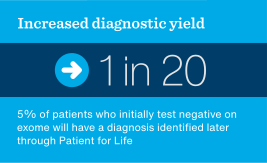
Ambry’s experts review exome sequencing data over time as scientific knowledge advances. If new discoveries help explain genetic test results, updated result reports are shared proactively with the healthcare provider who ordered the test. This program is provided at no additional cost to patients or families, with no time limit.



Support That Continues Over Time
We don’t limit the number of requests a healthcare provider can make or the timing of requests. When there’s been a significant change to a patient’s clinical phenotype, a healthcare provider can make a request for an exome reanalysis report.
How Patient for Life Works

1. Research Review

2. Continuous Reanalysis

3. Revised Reporting
![reclassification-percentages-PieChart[1]](https://ambrygen.com/wp-content/uploads/2026/04/reclassification-percentages-PieChart1.svg)
Patient for Life Drives Most Reclassifications, Through Lab-Led Reanalysis
Each year, over 100 new gene-disease relationships are identified,[3] reflecting the dynamic nature of genomic science. Many genes still have an unclear connection to human disease, underscoring the need for continuous, lab-driven reanalysis to ensure the most up-to-date findings are applied to patient data. [4]
![clinician-vs-laboratory-initiated-reclassification[1]](https://ambrygen.com/wp-content/uploads/2026/04/clinician-vs-laboratory-initiated-reclassification1.png)
This focus on continuous reanalysis ensures that the most up-to-date findings are always applied to patient data. Learn more about our excellence in gene classification and variant classification.
Published data demonstrates the power of a lab-driven approach. Reanalysis initiated by the laboratory led to a 54% diagnostic reclassification rate (p < 0.0001), compared to just 4% for clinician-initiated requests. [1] Most provider-initiated reanalyses did not result in any reclassification, emphasizing the value of continuous, proactive review in identifying clinically relevant updates.

Equitable Access to Genetic Discovery
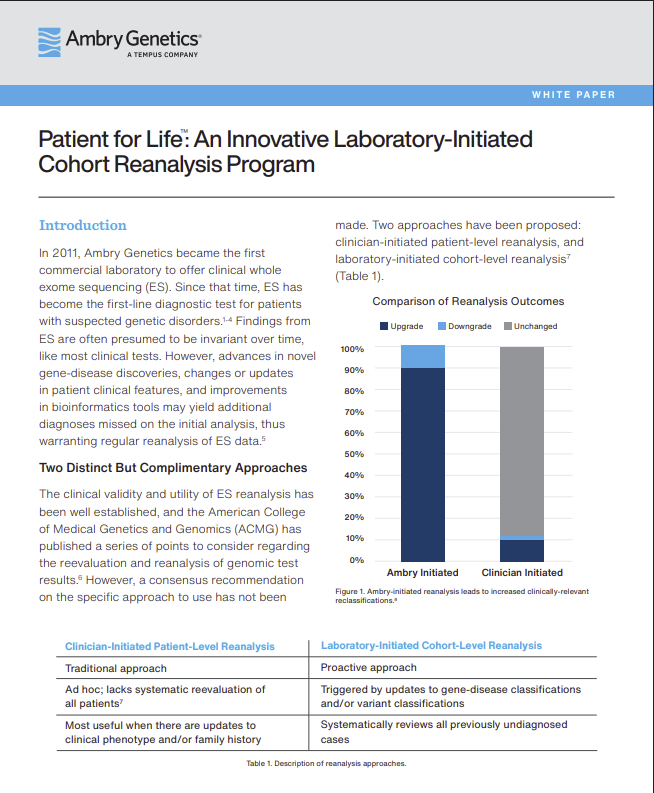
Download the White Paper
Download Patient for Life: An Innovative Laboratory-Initiated Cohort Reanalysis Program
Offering Peace of Mind for Families
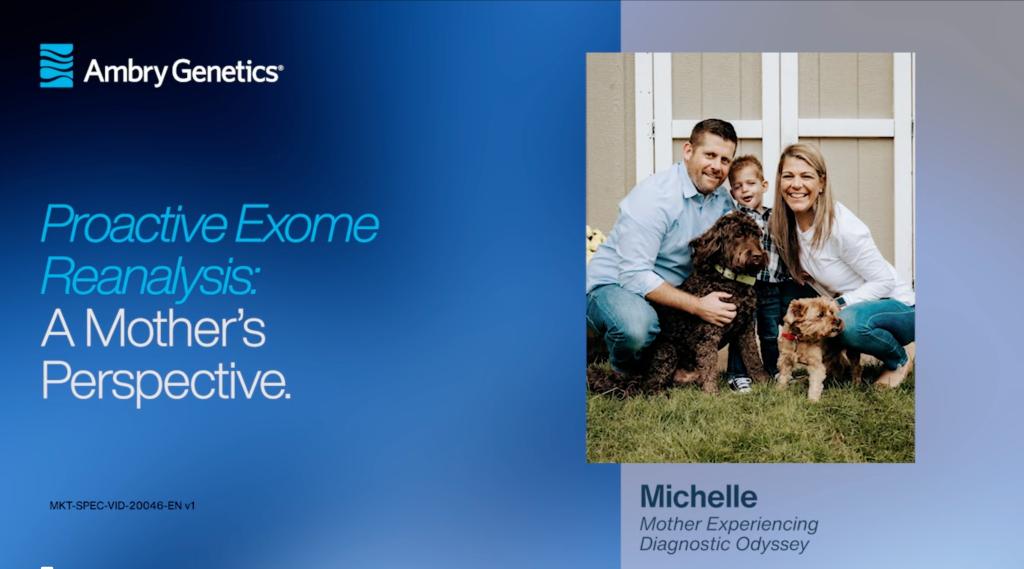
Michelle, Owen’s mom, shares how Patient for Life gives her the confidence that an entire team is continuing to search for answers for her family, acting as partners on the diagnostic journey.
References
- Towne MC, Huang J, Saliganan S, et al. Impact of laboratory-driven proactive reanalysis: reclassification to positive in 5% of initially negative or uncertain exome sequencing cases. Genet Med. 2025;101464. doi:10.1016/j.gim.2025.101464
- Deignan JL, Chung WK, Kearney HM, et al. Points to consider in the reevaluation and reanalysis of genomic test results: a statement of the American College of Medical Genetics and Genomics (ACMG). Genet Med. 2019;21(6):1267-1270. doi:10.1038/s41436-019-0478-1
- Ambry Genetics, internal data on file.
- OMIM Pace of Gene Discovery Graph. Available at https://www.omim.org/statistics/paceGraph. Accessed 6/12/2024.
- Giles A et al. Addressing equity in exome sequencing: Proactive reanalysis helps to reduce racial, ethnic and ancestral disparities. Platform presented at: National Society of Genetic Counselors conference; October 2023; Chicago, IL, USA.


![overlay-bottom[1]](https://ambrygen.com/wp-content/uploads/2026/02/overlay-bottom1.svg)