






Welcome to the Gene Scene! Each week, we will explore a gene from the ACMG Secondary Findings list—genes identified by the American College of Medical Genetics and Genomics as having clear, actionable health implications. These genes are included because they’re linked to serious but preventable or manageable conditions when identified early. Here, we focus on the condition that led to the gene’s inclusion on the list, providing clear, relevant information that supports your clinic. To subscribe to the Gene Scene, contact your local GSL or send a request to info@ambrygen.com.
To access the Gene Scene archives, visit our blog.
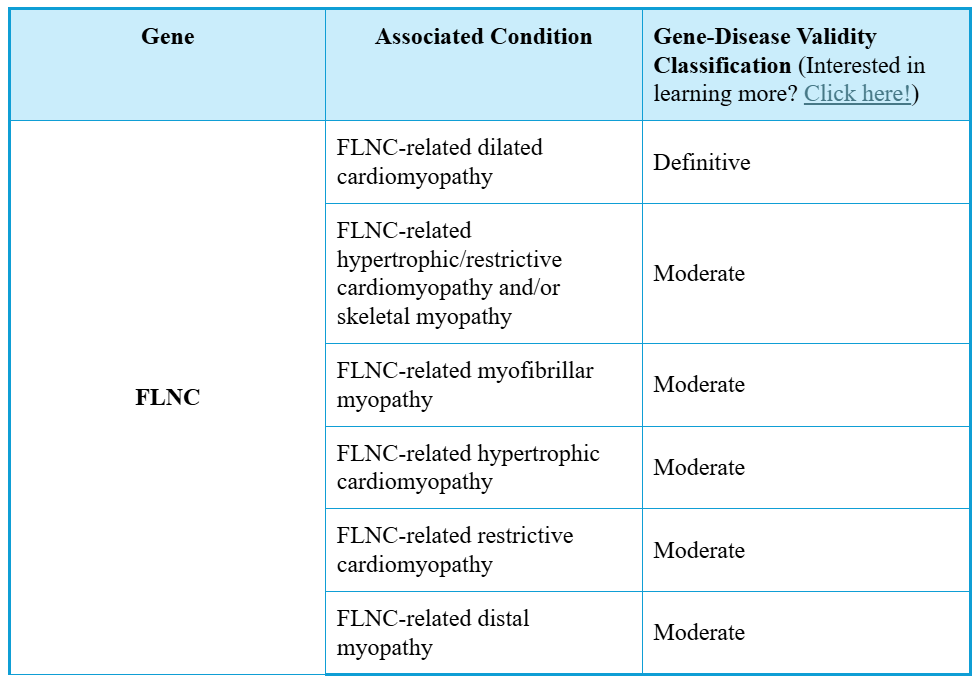
Clinical Phenotype Summary:
The FLNC gene (NM_001458.4), which contains 48 coding exons and is located on chromosome 7q32.1, encodes the filamin-C protein. Pathogenic variants in this gene are known to cause FLNC-related dilated cardiomyopathy (DCM), which is inherited in an autosomal dominant fashion, and have been associated with a spectrum of other FLNC-related filaminopathies, including FLNC-related hypertrophic (HCM) and restrictive (RCM) cardiomyopathies, myofibrillar myopathy (MFM), and distal myopathy, which are also inherited in an autosomal dominant fashion.
FLNC-related DCM is characterized by:
- Left ventricular dilation
- Ventricular arrhythmias
- Myocardial fibrosis
- A high risk of sudden cardiac death
- Some cases present with fibrofatty replacement of cardiomyocytes, primarily in the left ventricle, often described as arrhythmogenic cardiomyopathy (ACM)
Loss of function has been reported as the mechanism of disease for FLNC-related DCM.
FLNC-related HCM is characterized by:
- Left ventricular hypertrophy
- Hypertrophic septum
- An increased risk for sudden cardiac death
FLNC-related RCM is characterized by:
- Ventricular stiffness resulting in severe diastolic dysfunction
- Restrictive filling due to abnormal ventricular relaxation
- Dilated atria leading to heart failure
FLNC-related MFM is characterized by:
- Primarily proximal lower limb weakness with progression to other muscle groups
- Inability to walk, muscle pain, and respiratory weakness
Individuals with FLNC-related HCM, RCM, and MFM have distinctive protein aggregates identified on muscle biopsy.
Missense variants reported to cause dominant negative effects have been reported as the mechanism of disease for these FLNC-related filaminopathies.
FLNC-related distal myopathy is characterized by:
- Progressive muscle weakness presenting in distal muscles
- Particularly handgrip weakness beginning in adulthood, with progression to proximal muscles and muscle atrophy in the upper and lower limbs.
Mechanism of disease is unclear for FLNC-related distal myopathy.
Clinical Resources:
Ambry Knows Genes:
Scientific Posters:
EducateNext Webinars:
Field Guidance for Genetic Screening in Patients with Cardiomyopathies with Amy Kontorovich, MD, PhD (May 2023)
ACMG Secondary Findings Cardiology: Getting to the Heart of the Matter with Kelly Radtke, PhD (Sept 2024)
Citations:
Begay RL et al. JACC Clin Electrophysiol, 2018 Apr;4:504-514 PMID: 30067491
Brodehl A et al. Hum Mutat, 2016 Mar;37:269-79 PMID: 26666891
Celeghin R et al. Heart Rhythm, 2022 Feb;19:235-243 PMID: 34601126
Duff RM et al. Am J Hum Genet, 2011 Jun;88:729-740 PMID: 21620354
Kley RA et al. Brain, 2012 Sep;135:2642-60 PMID: 22961544
Ortiz-Genga MF et al. J Am Coll Cardiol, 2016 Dec;68:2440-2451 PMID: 27908349
Tucker NR et al. Circ Cardiovasc Genet, 2017 Dec;10 PMID: 29212899
Valdés-Mas R et al. Nat Commun, 2014 Oct;5:5326 PMID: 25351925
Velardo D et al. Front Neurol, 2022 Jul;13:930039 PMID: 35903116
Verdonschot JAJ et al. Hum Mutat, 2020 Jun;41:1091-1111 PMID: 32112656
Vorgerd M et al. Am J Hum Genet, 2005 Aug;77:297-304 PMID: 15929027
Walsh R et al. Nat Rev Cardiol, 2022 Mar;19:151-167 PMID: 34526680
Ambry Genetics Gene-Disease Validity Scheme
Each week, we explore a gene from the ACMG Secondary Findings list—genes identified by the American College of Medical Genetics and Genomics as having clear, actionable health implications. These genes are included because they’re linked to serious but preventable or manageable conditions when identified early.
To learn more about the ACMG Secondary Findings list, click here.
To read all previous Gene Scene emails, click here.


![overlay-bottom[1]](https://ambrygen.com/wp-content/uploads/2026/02/overlay-bottom1.svg)