





Your weekly snapshot of clinically actionable genes from the ACMG Secondary Findings List
Clinical Phenotype Summary:
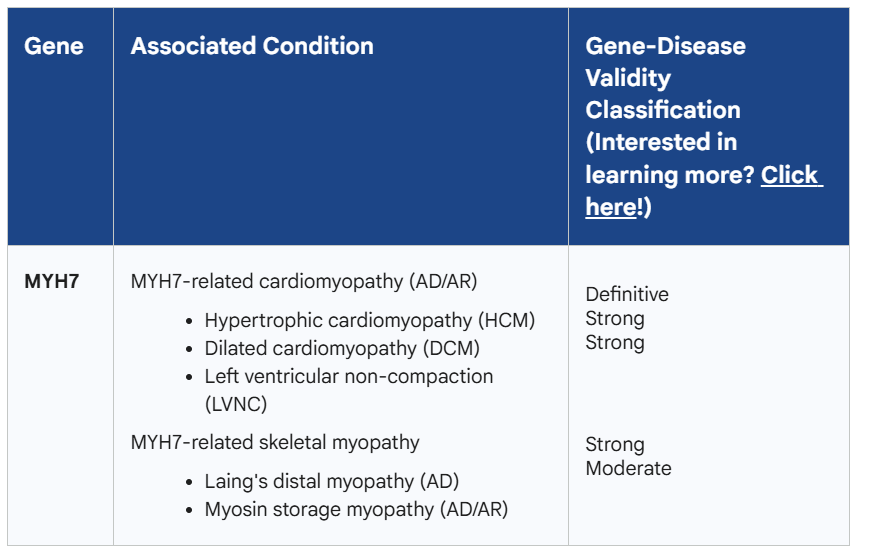
The MYH7 gene (NM_000257.4), which contains 38 coding exons and is located on chromosome 14q11.2, encodes the myosin-7 protein. Pathogenic variants in this gene have been associated with a spectrum of MYH7-related cardiomyopathies, which are typically inherited in an autosomal dominant fashion; MYH7-related early onset cardiomyopathy, which is inherited in an autosomal recessive fashion; and a spectrum of skeletal myopathies, which can be inherited in an autosomal dominant or autosomal recessive fashion.
MYH7-related conditions are characterized by:
- Hypertrophic cardiomyopathy (HCM): defined by increased septal or posterior wall thickness, often leading to early onset syncope (fainting), ventricular fibrillation, episodic chest pain, dyspnea, and cardiac arrest.
- Dilated cardiomyopathy (DCM): defined by ventricular dilation, reduced systolic function, and impaired contractility, generally presenting with heart failure with symptoms of congestion, arrhythmias and/or conduction system disease, or thromboembolic disease, including stroke.
- Left ventricular non-compaction (LVNC): characterized by excessive and prominent trabeculations of the left ventricle with deep intertrabecular recesses and a thickening of the endocardial noncompacted layer.
- Laing distal myopathy: characterized by early onset of weakness in the ankles presenting as foot drop. Additional features include weakness of finger extensors, contractures, and scoliosis.
- MYH7-related autosomal dominant myosin storage myopathy: characterized by mild muscle weakness in childhood with a slow progression to ambulation difficulties. Additional features seen in the autosomal recessive form include respiratory failure, cardiomyopathy, and/or scoliosis.
Pathogenic variants in MYH7 account for approximately 40% of HCM cases and 4% of DCM cases. Reduced penetrance and variable expressivity have been reported for autosomal dominant MYH7-related cardiomyopathies. Autosomal recessive MYH7-related cardiomyopathy typically has a more severe phenotype with an earlier age of onset.
Unique Considerations:
- Mechanism of disease is unclear for MYH7-related cardiomyopathies and MYH7-related skeletal myopathies.
- Mechanism of disease is NOT loss of function due to haploinsufficiency.
Clinical Resources:
- Understanding Your Positive Cardiomyopathy Genetic Test Result
- Understanding Your Negative Cardiomyopathy Genetic Test Result
- Understanding Your VUS Cardiomyopathy Genetic Test Result
Ambry Knows Genes:
Peer-Reviewed Publications:
- Clinical validity of autosomal dominant ALPK3 loss-of-function variants as a cause of hypertrophic cardiomyopathy (Circulation: Genomic and Precision Medicine, April 2025)
- Genes associated with hypertrophic cardiomyopathy: A reappraisal by the ClinGen Hereditary Cardiovascular Disease Gene Curation Expert Panel (JACC, February 2025)
- Harmonizing the Collection of Clinical Data on Genetic Testing Requisition Forms to Enhance Variant Interpretation in Hypertrophic Cardiomyopathy (HCM): A Study from the ClinGen Cardiomyopathy Variant Curation Expert Panel (The Journal of Molecular Diagnostics, May 2021)
Scientific Presentations:
Scientific Posters:
- Exploring the yield of RASopathy variants in individuals with presumed nonsyndromic hypertrophic cardiomyopathy (NSGC, November 8, 2025)
- Down the Rabbit Hole: Tales of A Tiered Approach to Genetic Testing for HCM (NSGC, September 14, 2017)
- Diagnostic yield and mutation spectrum of multigene panel testing for hypertrophic cardiomyopathy (ASHG, October 19, 2017)
To read more about Ambry’s research on this gene, visit the ‘Our Research’ dropdown on our website https://www.ambrygen.com/science.
Citations:
Yu M et al. Orphanet J Rare Dis, 2020 12;15:344. PMID: 33298082
Richard P et al. J Mol Cell Cardiol, 2000 Aug;32:1575-83. PMID: 10900182
Walsh R et al. Cardiology, 2010 Oct;115:49-60. PMID: 19864899
Tajsharghi H et al. Acta Neuropathol, 2013 Jan;125:3-18. PMID: 22918376
Beecroft SJ et al. Neuromuscul Disord, 2019 06;29:456-467. PMID: 31130376
Ambry Genetics Gene-Disease Validity Scheme
Each week, we explore a gene from the ACMG Secondary Findings list—genes identified by the American College of Medical Genetics and Genomics as having clear, actionable health implications. These genes are included because they’re linked to serious but preventable or manageable conditions when identified early.
To learn more about the ACMG Secondary Findings list, click here.
To read all previous Gene Scene emails, click here.


![overlay-bottom[1]](https://ambrygen.com/wp-content/uploads/2026/02/overlay-bottom1.svg)