





Your weekly snapshot of clinically actionable genes from the ACMG Secondary Findings List.
Clinical Phenotype Summary:
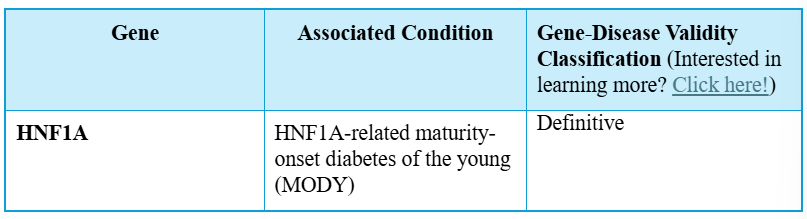
The HNF1A gene is located on chromosome 12 and encodes the hepatocyte nuclear factor 1-alpha protein. HNF1A is involved in regulating insulin expression and beta-cell development, proliferation and apoptosis. Pathogenic variants in this gene are known to cause HNF1A-related maturity-onset diabetes of the young (MODY), type 3, which is inherited in an autosomal dominant fashion. MODY is a group of disorders of non-autoimmune diabetes mellitus which usually present in adolescence or young adulthood.
MODY is characterized by:
- Early-onset diabetes mellitus and micro- and macrovascular complication, including, retinopathy
- Unique features uncommon in type 1 and type 2 diabetes that are found in MODY:
- Absence of pancreatic cell islet autoantibodies
- Low insulin requirement for treatment
- Lack of ketoacidosis when insulin is omitted from treatment
- Lack of significant obesity or acanthosis nigricans
- Normal triglyceride levels and/or normal or elevated high-density lipoprotein cholesterol
Unique Considerations:
Loss-of-function variants in this HNF1A are the most common cause of familial diabetes and have a high penetrance (96% by age 55).
Clinical Resources:
Understanding your Secondary Findings Result
Citations:
Yamagata K et al. Nature. 1996 Dec 5;384(6608):455-8. PMID: 8945470
Amed S et al. Can J Diabetes. 2016 Oct;40(5):449-454. PMID: 27130141
Ellard S et al. Diabetologia. 2008 Apr;51(4):546-53. PMID: 18297260
Skoczek D et al. Int J Mol Sci. 2021 Jul 14;22(14):7553. PMID: 34299172
Ambry Genetics Gene-Disease Validity Scheme
Each week, we explore a gene from the ACMG Secondary Findings list—genes identified by the American College of Medical Genetics and Genomics as having clear, actionable health implications. These genes are included because they’re linked to serious but preventable or manageable conditions when identified early.
To learn more about the ACMG Secondary Findings list, click here.
To read all previous Gene Scene emails, click here.


![overlay-bottom[1]](https://ambrygen.com/wp-content/uploads/2026/02/overlay-bottom1.svg)