



![shape-element-one[1]](https://ambrygen.com/wp-content/uploads/2026/03/shape-element-one1.svg)
![shape-element-two[1]](https://ambrygen.com/wp-content/uploads/2026/03/shape-element-two1.svg)
Sanger sequencing to optimize accuracy
Our research-backed Sanger sequencing confirmation maximizes test sensitivity and specificity, reducing the chance of false positives or missing real mutations.
Resolving NGS Limitations with Sanger Confirmation
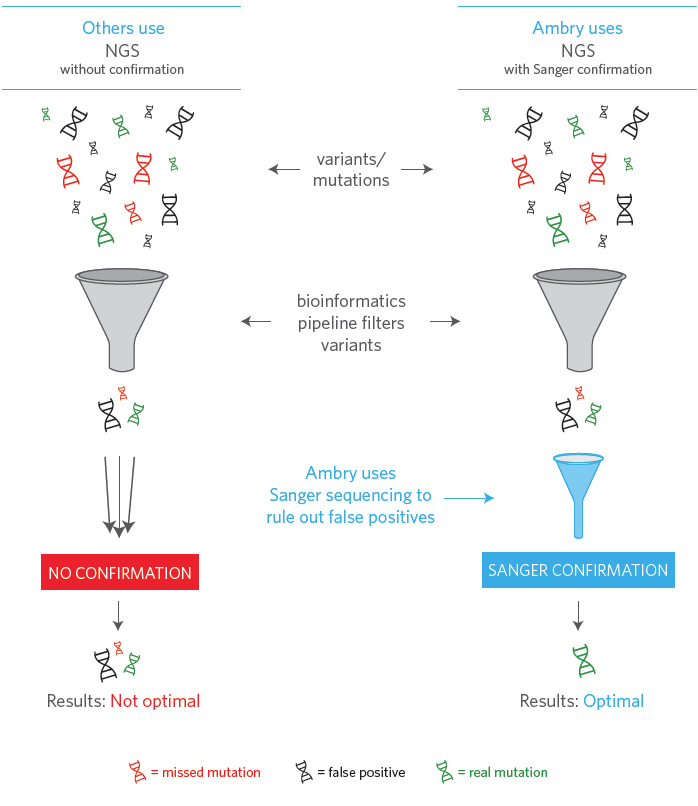
Next generation sequencing (NGS) without Sanger confirmation means test sensitivity and specificity are not optimized. Ambry’s landmark study—the largest of its kind—demonstrated that 1.3% of mutations identified without Sanger confirmation would be false positives. Conversely, tightening bioinformatics filters to eliminate these false positives would result in missing 2% of true mutations (Mu et al., November 2016).
These findings guided implementation of additional Sanger sequencing confirmation at specific, well-defined thresholds. This reduces the risk of reporting false positives or missing true mutations, delivering trustworthy results to healthcare providers who use them to guide patient care.
Experience that Powers Precision
References:
- Mu W, Lu H-M, Chen J, Li S, Elliott AM. Sanger confirmation is required to achieve optimal sensitivity and specificity in next-generation sequencing panel testing. The Journal of Molecular Diagnostics. November 2016 18(6):923-32.