






Welcome to the Gene Scene! Each week, we will explore a gene from the ACMG Secondary Findings list—genes identified by the American College of Medical Genetics and Genomics as having clear, actionable health implications. These genes are included because they’re linked to serious but preventable or manageable conditions when identified early. Here, we focus on the condition that led to the gene’s inclusion on the list, providing clear, relevant information that supports your clinic. To subscribe to the Gene Scene, contact your local GSL or send a request to info@ambrygen.com.
To access the Gene Scene archives, visit our blog.
Clinical Phenotype Summary
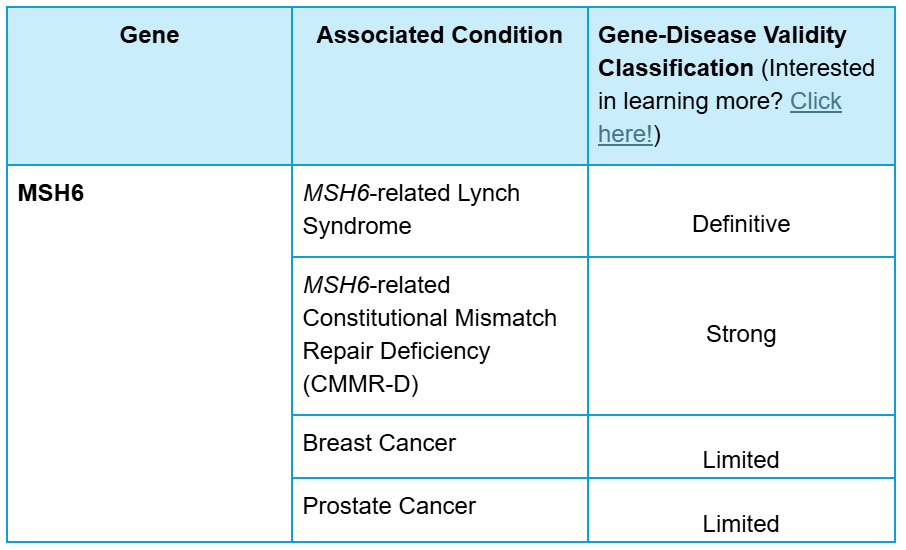
The MSH6 gene (NM_000179.2) is located on chromosome 2p16.3, encodes the DNA mismatch repair protein Msh6, and contains 10 coding exons. Pathogenic variants in this gene are known to cause MSH6-related Lynch syndrome (previously known as hereditary non-polyposis colorectal cancer or HNPCC), which is inherited in an autosomal dominant fashion, and constitutional mismatch repair deficiency (CMMR-D) syndrome, which is inherited in an autosomal recessive fashion.
MSH6-related Lynch Syndrome is characterized by:
- Significantly increased risk for
- Colon cancer (10-44% cumulative lifetime risk)
- Endometrial cancer (16-49% cumulative lifetime risk in females)
- Ovarian cancer (≤1-13% cumulative lifetime risk in females)
- Cancers of the small bowel, stomach, pancreas, biliary tract, and renal/bladder (urothelial)
- Risks for cancers of the sebaceous glands (a variant of Lynch syndrome also known as Muir Torre syndrome) and central nervous system may also be elevated when compared to the general population
Some studies have estimated that mutations in mismatch repair (MMR) genes may be related to an approximately 2-fold increase in prostate cancer risk; however, new data suggests that this risk may be attributed primarily to mutations in MSH2, and that this risk may be less significant for other MMR genes Overall, lifetime cancer risks for individuals with MSH6 pathogenic variants are estimated to be lower than those associated with pathogenic variants in the MLH1 and MSH2 genes
Variable expressivity is observed; therefore, cancer risks will differ based on individual and family history.
Loss of function has been reported as the mechanism of disease for MSH6-related Lynch syndrome.
MSH6-related CMMR-D is characterized by:
- Café au lait macules
- Increased risk for hematologic malignancies, brain tumors, and early-onset Lynch syndrome-associated cancers
Individuals of reproductive age are at 25% risk of having a child with CMMR-D with each pregnancy when both biological parents have a pathogenic variant in MSH6.
Biallelic loss of function has been reported as the mechanism of disease for CMMR-D.
Unique Considerations:
Microsatellite Instability (MSI) data alone is not enough to diagnose Lynch syndrome. 10-15% of sporadic CRC exhibit MSI.
There are multiple Founder Mutations in MSH6:
Dutch
- MSH6 c.467C>G (p.S156*) (PMID:18625694)
- MSH6 c.650dupT (p.Lys218*) (PMID: 11709755)
- MSH6 c.1614_1615delCTinsAG (p.Y538_L539DELINS*V) (PMID:18625694)
Swedish
- MSH6 c.2931C>A (p.Y977*) (PMID: 16283884)
- MSH6 c.1346T>C (p.L449P) (PMID: 16283884)
Ashkenazi Jewish
- MSH6 c.3959_3962DELCAAG (p.A1320Efs*6) (PMID:21155762)
- MSH6 c.3984_3987DUPGTCA (p.L1330Vfs*12) (PMID:21155762)
- MSH6 c.3959_3962del (p.A1320fs) (PMID: 21155762)
- MSH6 c.3984_3987dup (p.L1330fs) (PMID: 21155762)
French Canadian
- MSH6 c.10C>T (p.Q4*) (PMID:25318681)
Finnish
- MSH6 c.2983G>T (p.E995*) (PMID: 15805151)
Clinical Resources:
Clinician Management Resource and Understanding Your Result – MSH6
Ambry Knows Genes:
Peer-Reviewed Publications:
Comparison of Somatic and Germline Variant Interpretation in Hereditary Cancer Genes
Tumour characteristics provide evidence for germline mismatch repair missense variant pathogenicity
An alternative approach to establishing unbiased colorectal cancer risk estimation in Lynch syndrome
Scientific Presentations:
To read more about Ambry’s research on this gene. Visit the ‘Our Research’ dropdown on our website https://www.ambrygen.com/science.
Citations:
Bonadona V et al. JAMA, 2011 Jun;305:2304-10 PMID: 21642682
Møller P et al. Gut, 2018 07;67:1306-1316; Engel C et al. J Clin Oncol, 2012 Dec;30:4409-15 PMID: 28754778
Dominguez-Valentin M et al. Genet Med, 2020 01;22:15-25 PMID: 31337882
Wang C et al. JNCI Cancer Spectr. 2020 Apr 23;4(5) PMID: 32923933
Ryan S et al. Cancer Epidemiol. Biomarkers Prev. 2014 Mar;23(3):437-49 PMID: 24425144
Baglietto L et al. J Natl Cancer Inst. 2010 Feb 3;102(3):193-201 PMID: 20028993
Aronson M et al. J Med Genet. 2022 Apr;59(4):318-327 PMID: 33622763
Ambry Genetics Gene-Disease Validity Scheme
Each week, we explore a gene from the ACMG Secondary Findings list—genes identified by the American College of Medical Genetics and Genomics as having clear, actionable health implications. These genes are included because they’re linked to serious but preventable or manageable conditions when identified early.
To learn more about the ACMG Secondary Findings list, click here.
To read all previous Gene Scene emails, click here.


![overlay-bottom[1]](https://ambrygen.com/wp-content/uploads/2026/02/overlay-bottom1.svg)