





Your weekly snapshot of clinically actionable genes from the ACMG Secondary Findings List
Clinical Phenotype Summary:
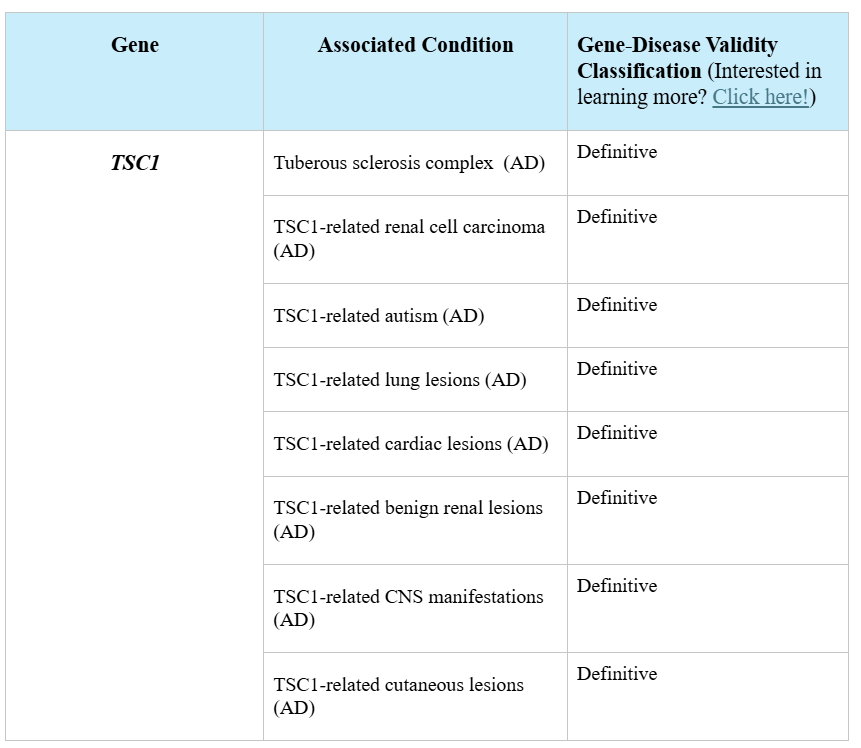
The TSC1 gene (NM_000368.4) is located on chromosome 9q34.13, encodes the hamartin protein, and contains 21 coding exons. Pathogenic variants in this gene are known to cause tuberous sclerosis complex (TSC), which is inherited in an autosomal dominant fashion. TSC is a highly variable condition.
Tuberous Sclerosis Complex (TSC) is characterized by:
- Skin manifestations (hypopigmented macules, facial angiofibromas, shagreen patch) occurring in nearly 100% of individuals
- Central nervous system (CNS) manifestations occurring in 90% of individuals, including subependymal nodules, cortical and subcortical tubers, seizures, and approximately 50% reporting intellectual disability and/or autism
- Renal lesions occurring in 80% of individuals (angiomyolipomas and cysts)
- Cardiac rhabdomyomas
- Lung lesions (specifically lymphangioleiomyomatosis (LAM))
- Major features: Multiple retinal nodular hamartomas, facial angiofibromas or fibrous cephalic plaque, ungual fibromas, shagreen patch, hypomelanotic macules, subependymal nodules, cortical dysplasias, subependymal giant cell astrocytoma (SEGA), renal angiomyolipoma, cardiac rhabdomyosarcoma, and pulmonary lymphangiomyomatosis (LAM)
- Minor features: Retinal achromic patches, dental enamel pits, intraoral fibromas, hypopigmented “confetti” skin lesions, renal epithelial cysts, and non-renal hamartomas
Onset of manifestations occurs predominantly prior to age 10, but can range from the prenatal period to late adulthood. The lifetime risk for renal cell carcinoma (including papillary, clear cell, and chromophobe type) is estimated at 2–5%, with an average age of diagnosis in the third decade of life.
Unique Considerations:
- Manifestations of TSC including seizures, renal angiomyolipoma, and SEGAs have been included in indications for approved mTOR inhibitor therapies.
- Pathogenic variants in TSC1 are estimated to account for approximately 26% of TSC.
- Approximately two-thirds of individuals have a de novo or mosaic pathogenic variant.
- Loss of function has been reported as the mechanism of disease for TSC.
Clinical Resources:
Ambry Knows Genes:
Peer-Reviewed Publications:
- TSC1 Variant Associated With Mild or Absent Clinical Features of Tuberous Sclerosis Complex in a Three-Generation Family, PMID: 32654957
To read more about Ambry’s research on this gene, visit the ‘Our Research’ dropdown on our website at https://www.ambrygen.com/science.
Citations:
- Tomoto K et al. BMC Neurol. 2021 Mar 31;21(1)139. PMID: 33789627
- Schubert-Bast S and Strzelczyk A. Ther Adv Neurol Disord. 2021 Jul 17;14:17562864211031100. PMID: 34354784
- Curatolo P, et al. (2024) World J Pediatr 20(1):40-53. PMID: 37934375
- Mitchell RA, et al. (2022) Dev Med Child Neurol 64(10):1214-1229. PMID: 35642436
- Shah RB, et al. (2024) Adv Anat Pathol 31(2):105-117. PMID: 38289899
- Man A, et al. (2024) Genes (Basel) 15(3). PMID: 38540821
- Northrup H, et al. GeneReviews. 1999 Jul 13 [Updated 2021 Dec 9]. PMID: 20301399
Ambry Genetics Gene-Disease Validity Scheme
Upcoming Ambry Events & Webinars:
- Ambry Genetics Clinical Education Webinar Series: Check our live schedule and register for upcoming sessions at Ambry Educational Webinars.
- EducateNext: Beyond DNA: Current RNA Insights in Cancer and Rare Disease (Webinar) – August 20, 2026 | 11:00 AM PDT [View Webinar]
Each week, we explore a gene from the ACMG Secondary Findings list—genes identified by the American College of Medical Genetics and Genomics as having clear, actionable health implications. These genes are included because they’re linked to serious but preventable or manageable conditions when identified early.
To learn more about the ACMG Secondary Findings list, click here.
To read all previous Gene Scene emails, click here.


![overlay-bottom[1]](https://ambrygen.com/wp-content/uploads/2026/02/overlay-bottom1.svg)