





Your weekly snapshot of clinically actionable genes from the ACMG Secondary Findings List.
Clinical Phenotype Summary:
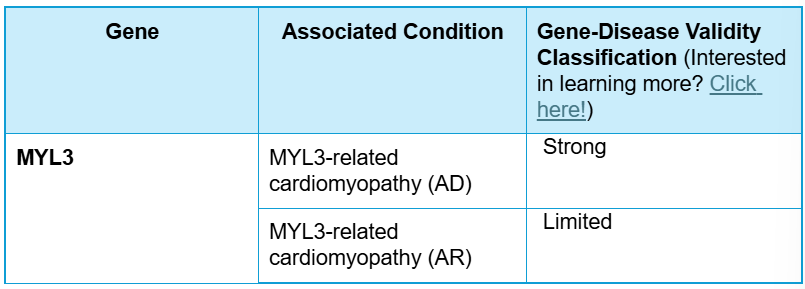
The MYL3 gene (NM_000258.2), which contains 6 coding exons and is located on chromosome 3p21.31, encodes the myosin light chain 3 protein. Pathogenic variants in this gene are known to cause MYL3-related cardiomyopathy, which is inherited in an autosomal dominant fashion. MYL3-related cardiomyopathy primarily presents as hypertrophic cardiomyopathy (HCM), which is defined by increased septal or posterior wall thickness, often leading to:
- early onset syncope
- ventricular fibrillation
- episodic chest pain
- dyspnea
- cardiac arrest
Other cardiomyopathy types have also been described.
Unique Considerations:
- Mechanism of disease is unclear for MYL3-related cardiomyopathy.
- Reduced penetrance and variable expressivity have been reported.
Clinical Resources:
- Understanding your Secondary Findings Result
- Understanding your Negative Hypertrophic Cardiomyopathy Result
Ambry Knows Genes:
Peer-Reviewed Publications:
- Genes associated with hypertrophic cardiomyopathy: A reappraisal by the ClinGen Hereditary Cardiovascular Disease Gene Curation Expert Panel (Journal of the American College of Cardiology, February 2025)
- Harmonizing the Collection of Clinical Data on Genetic Testing Requisition Forms to Enhance Variant Interpretation in Hypertrophic Cardiomyopathy (HCM): A Study from the ClinGen Cardiomyopathy Variant Curation Expert Panel (July 12, 2023)
Scientific Posters:
- Diagnostic yield and mutation spectrum of multigene panel testing for hypertrophic cardiomyopathy (ASHG, October 19, 2017)
- All in the Family: How Family History Affects Diagnostic Yield of Hypertrophic Cardiomyopathy Multigene Panel Testing (ASHG, October 2017)
Citations:
- Arad M et al. Circulation, 2005 Nov;112:2805-11. PMID: 16267253
- Yadav S et al. Pflugers Arch, 2019 05;471:683-699. PMID: 30706179
- Andersen PS et al. Biochem Res Int, 2012 Apr;2012:685108. PMID: 22957257
Ambry Genetics Gene-Disease Validity Scheme
Each week, we explore a gene from the ACMG Secondary Findings list—genes identified by the American College of Medical Genetics and Genomics as having clear, actionable health implications. These genes are included because they’re linked to serious but preventable or manageable conditions when identified early.
To learn more about the ACMG Secondary Findings list, click here.
To read all previous Gene Scene emails, click here.


![overlay-bottom[1]](https://ambrygen.com/wp-content/uploads/2026/02/overlay-bottom1.svg)