





Your weekly snapshot of clinically actionable genes from the ACMG Secondary Findings List.
Clinical Phenotype Summary:
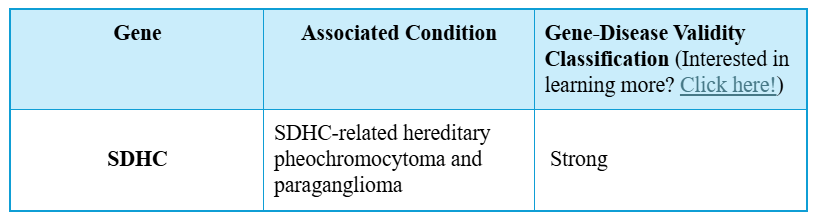
The SDHC gene (NM_003001.3) is located on chromosome 1q23.3, encodes the mitochondrial succinate dehydrogenase cytochrome b560 subunit protein and contains 6 coding exons. Pathogenic variants in this gene are known to cause SDHC-related hereditary pheochromocytoma-paraganglioma (PCC-PGL), which is inherited in an autosomal dominant fashion.
Pathogenic variants in SDHC confer a significantly increased risk for:
- Parasympathetic, non-catecholamine-secreting, unifocal, and benign PGLs (but sympathetic catecholamine-secreting PGLs and PCCs have also been reported)
Most SDHC-associated PGLs occur in the head and neck region (HNPGLs); however, mediastinal PGLs have also been reported (accounting for up to 10% of SDHC-related tumors).
Penetrance is reduced and appears to be lower with SDHC mutations when compared to SDHB or SDHD mutations, with cumulative lifetime risks estimated between 8%-25%. Loss of function has been reported as the mechanism of disease for SDHC-related hereditary PCC-PGL.
Unique Considerations:
- Risks may also be elevated for PCCs, gastrointestinal stromal tumors, or renal cancer; however, these tumors have rarely been reported in individuals with pathogenic variants in SDHC.
Clinical Resources:
Ambry Knows Genes:
Peer-Reviewed Publications:
- Universal Germline Panel Testing for Individuals With Pheochromocytoma and Paraganglioma Produces High Diagnostic Yield (The Journal of Clinical Endocrinology and Metabolism, April 2022)
To read more about Ambry’s research on this gene, visit the ‘Our Research’ dropdown on our website https://www.ambrygen.com/
Citations:
- Else T, et al. (2014) J. Clin. Endocrinol. Metab. 99(8):E1482-6. PMID: 24758179
- Andrews KA, et al. (2018) J. Med. Genet. 55(6):384-394. PMID: 29386252
- Amar L, et al. (2021) Nat Rev Endocrinol 17(7):435-444. PMID: 34021277
- Ricketts CJ, et al. (2012) J. Urol. 188(6):2063-71. PMID: 23083876
- Benn DE, et al. (2018) J Med Genet 55(11):729-734. PMID: 30201732
- WIlliams ST, et al. (2022) Clin Endocrinol (Oxf) 96(4):499-512. PMID: 34558728
Ambry Genetics Gene-Disease Validity Scheme
Each week, we explore a gene from the ACMG Secondary Findings list—genes identified by the American College of Medical Genetics and Genomics as having clear, actionable health implications. These genes are included because they’re linked to serious but preventable or manageable conditions when identified early.
To learn more about the ACMG Secondary Findings list, click here.
To read all previous Gene Scene emails, click here.


![overlay-bottom[1]](https://ambrygen.com/wp-content/uploads/2026/02/overlay-bottom1.svg)