







Welcome to the Gene Scene! Each week, we will explore a gene from the ACMG Secondary Findings list—genes identified by the American College of Medical Genetics and Genomics as having clear, actionable health implications.These genes are included because they’re linked to serious but preventable or manageable conditions when identified early. Here, we focus on the condition that led to the gene’s inclusion on the list, providing clear, relevant information that supports your clinic. To subscribe to the Gene Scene, contact your local GSL or send a request to info@ambrygen.com.
To access the Gene Scene archives, visit our blog. 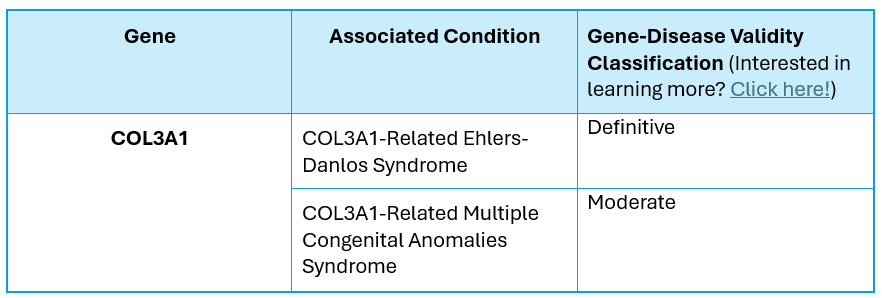
Clinical Phenotype Summary:
The COL3A1 gene (NM_000090) is located on chromosome 2q32.2 and encodes the collagen, type III, alpha-1 protein. Alterations in this gene are generally inherited in an autosomal dominant fashion in association with Ehlers-Danlos syndrome, vascular type (EDSVASC), also known as Ehlers-Danlos syndrome, type IV. Biallelic alterations in the COL3A1 gene have also been described in patients who present with structural brain anomalies with or without a severe EDSVASC phenotype.
• Thin and translucent skin
• Easy bruising
• Joint laxity/hypermobility
• Characteristic facial appearance with thin vermilion of the lips, micrognathia, narrow nose, and prominent eyes
• Vascular dissection or rupture
• Gastrointestinal perforation or organ rupture n
• Neonates may present with clubfoot, hip dislocation, limb deficiency, and/or amniotic bands
• Variable phenotype expression has been reported between and within families
• Developmental delay
• Seizures
• Translucent skin
• Joint laxity/hypermobility
• Brain anomalies including bilateral frontoparietal polymicrogyria, cobblestone-like cortical malformation, cerebellar cysts, and cortical dysplasia
• Understanding Your Positive Genetic Test Result for Thoracic Aortic Aneurysms/Dissections (TAAD) or Related Conditions
• Understanding your Secondary Findings Result
• Kuivaniemi H, et al. Gene vol. 707 (2019): 151-171. PMID: 31075413
• Horn D, et al. American journal of medical genetics. Part A 2017 Sep; 173(9):2534-2538. PMID: 28742248
• Pepin M, et al. Genetics in medicine : official journal of the American College of Medical Genetics vol. 16,12 (2014): 881-8. PMID: 24922459
• Pepin M, et al. The New England journal of medicine vol. 342,10 (2000): 673-80. PMID: 10706896


![overlay-bottom[1]](https://ambrygen.com/wp-content/uploads/2026/02/overlay-bottom1.svg)